
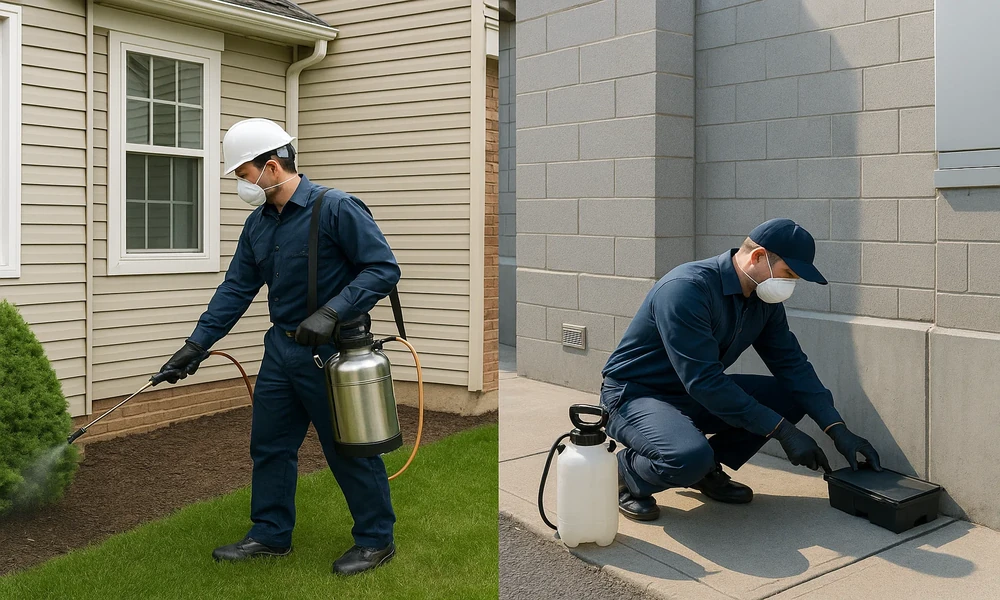

Main Sail Pest Control gets this question on nearly every first visit, usually phrased as “is it safe for the dog.” The honest answer starts with a correction: no pesticide label in the United States is legally allowed to say “safe.” The EPA prohibits claims that a registered pesticide is safe or non-toxic, so any company advertising a “kid safe” or “pet safe” treatment is using marketing language, not regulatory language. What actually protects your family is a combination of product selection, placement, and the re-entry interval on the label.
Why can’t a pesticide legally be called safe?
Under the Federal Insecticide, Fungicide, and Rodenticide Act, pesticide labeling cannot be false or misleading, and the EPA specifically treats claims like “safe,” “non-toxic,” and “harmless” as misbranding, even when qualified with phrases such as “when used as directed.”
What a label does carry is a signal word, which is the one-word toxicity indicator required on every registered product:
- Caution, the lowest of the three, meaning relatively low acute toxicity
- Warning, indicating moderate acute toxicity
- Danger, the highest, sometimes paired with a skull-and-crossbones for highly toxic products
Most products applied around a Lake Elsinore home for ants, spiders, or roaches carry Caution. The signal word describes the concentrate, though, not the diluted mixture on your baseboard, which is a distinction worth understanding when someone shows you a jug.
What is a re-entry interval, and how long do I actually need to stay out?
A re-entry interval is the period the label requires before people or pets can return to a treated area. For residential structural products, the standard requirement is to keep people and pets off treated surfaces until the application has dried.
That drying time is the number that matters day to day. In practice:
- Interior baseboard and crack-and-crevice applications typically dry in about two to four hours depending on ventilation
- Exterior liquid perimeter applications on stucco and concrete usually dry within one to two hours in Lake Elsinore’s climate, faster in summer heat
- Granular products in landscape beds are generally safe once watered in and the area has dried
- Bait stations and gel baits have no drying wait, since the material is contained or placed where pets and children cannot reach it
- Fumigation is an entirely different category, with tenting requiring vacancy typically of two to three days and a formal clearance before reoccupancy
Ask for the specific interval rather than a general reassurance. A technician who cannot tell you what the label says about re-entry has not read it.
Which product choices reduce exposure the most?
Placement reduces exposure more than product selection does. Two applications of the same active ingredient can produce very different exposure depending on where they go.
Lower-exposure approaches used in and around homes with pets and small children:
- Enclosed and tamper-resistant bait stations rather than broadcast bait
- Gel bait placed in cabinet voids, hinge recesses, and behind appliances where hands and paws do not reach
- Crack-and-crevice injection rather than surface spraying of floors and baseboards
- Insecticidal dusts in wall voids, attics, and weep holes, which stay where they are placed
- Insect growth regulators, which interfere with insect development and have low vertebrate toxicity
- Boric acid and borate formulations in inaccessible voids
- Exterior perimeter focus, keeping treatment on the foundation band, eaves, and entry points rather than inside living space
California has also narrowed rodenticide options considerably. AB 1788 restricted second-generation anticoagulant rodenticides statewide and AB 1322 extended a moratorium to first-generation anticoagulants, with limited exemptions, administered by the California Department of Pesticide Regulation. Snap traps in tamper-resistant boxes and exclusion have largely replaced bait for residential rodent work, which happens to be the lower-risk choice for dogs and non-target wildlife.
Does living near the lake change what should be applied?
Yes, and it is one of the more overlooked parts of a Lake Elsinore treatment plan. Pyrethroid insecticides, the most common class in residential pest control, are highly toxic to fish and aquatic invertebrates, and their labels carry environmental hazard statements restricting application where runoff can reach water.
California surface water regulations further limit how pyrethroids may be applied outdoors around structures, generally restricting treatment to specific areas such as a narrow band along the foundation, under eaves, and around entry points, and prohibiting application to sidewalks, driveways, and other impervious surfaces where runoff carries product to storm drains.
For homes with koi ponds, fountains, or backyard aquaculture, tell the technician before work begins. Covering a pond and shutting off a fountain during application, then keeping product off adjacent hardscape, is standard practice and should not require prompting.
What Main Sail Pest Control recommends asking before anyone treats
Six questions separate a considered treatment from a routine spray:
- What product are you applying, and can I see the label or the Safety Data Sheet
- What is the re-entry interval, and when specifically can the kids and the dog be back in that area
- Where are you applying it, and are you treating inside living space or focusing on the exterior and voids
- Are you using bait stations or gels instead of liquid where that is an option
- What can I do myself that reduces the amount of product needed
- Where will bait stations be placed, and are they tamper-resistant
The sixth answer matters most for dog owners. That last point about reducing product is where integrated pest management earns its keep. Sealing a garage door sweep, moving mulch back from the foundation, fixing a leaking hose bib, and cleaning up fallen fruit routinely cuts the treatment needed more than switching active ingredients does.
Safety in pest control is a function of what gets used, where it goes, and how long you wait, not a phrase on a truck. Ask for the label, ask for the drying time, and expect bait and void placements where they will do the job. If you want a treatment plan built around a house with kids, dogs, or a pond, Main Sail Pest Control will walk the property with you and explain every product and placement before anything is applied.
