
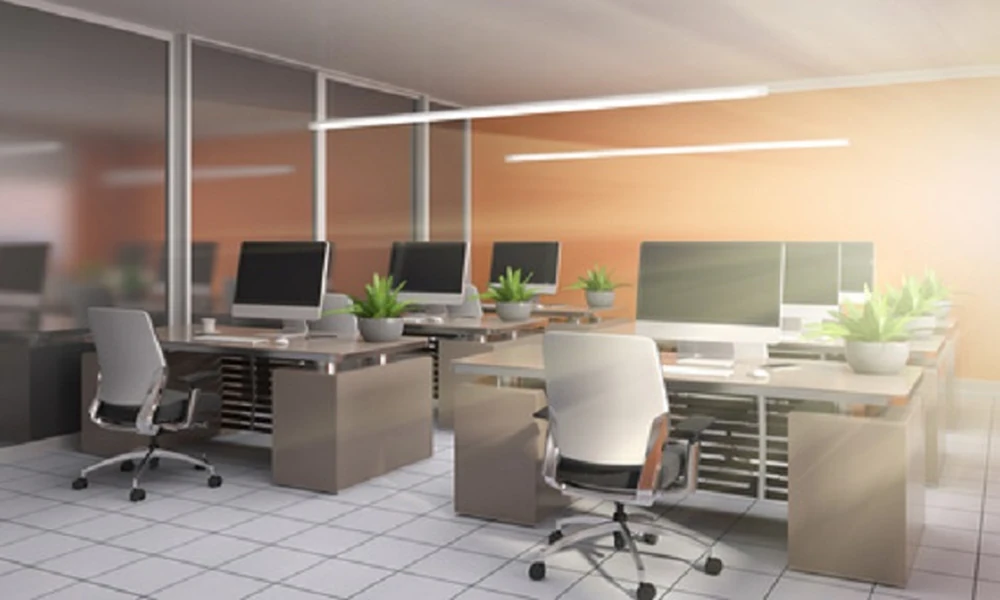

Office desk partitions address the tension at the heart of open-plan office design: the need for collaboration alongside the need for focus. An entirely open office maximises visibility and communication but eliminates the privacy that sustained, focused work requires. An office subdivided into individual enclosed rooms maximises privacy but inhibits the spontaneous communication that open plans enable. Desk partitions sit between these extremes, creating workstation-level boundaries that give each person a defined personal space without fully enclosing the team.
How Desk Partitions Affect Productivity
Research on office environments consistently identifies acoustic and visual distraction as two of the primary causes of reduced productivity in open-plan offices. A colleague’s conversation, a phone call overheard, or the visual distraction of movement across the floor are all well-documented productivity inhibitors.
Office desk partitions address both types of distraction. Visual partitions reduce the line of sight from one workstation to adjacent activity. Acoustic partitions absorb sound, reducing the transmission of conversation and noise across the workstations they divide. The combination of reduced visual and acoustic distraction creates a workstation environment that allows focused work without requiring full enclosure.
Partition Heights and Their Applications
Desk partition height is the primary variable that determines the balance between privacy and openness in a workstation layout.
Low partitions of between 40 and 60 centimetres function primarily as surface organizers – they define the desk boundary and provide a surface for personal items, screens, or documents, but offer minimal privacy.
Medium partitions between 120 and 140 centimetres sit below standing eye level. They provide visual privacy for seated workers – a colleague at the adjacent workstation cannot easily see the screen or the documents of the person next to them – while allowing the workspace to feel open when people stand.
High partitions above 150 centimetres create more substantial visual screening. In some configurations, they approach the acoustic performance of partial walls.
Panel Materials and Acoustic Performance
Desk partitions in Singapore offices are available in fabric, laminate, glass, and combination materials. Fabric panels have the highest acoustic absorption of standard partition materials. Laminate panels are durable and easy to clean but reflect sound rather than absorbing it. Glass panels provide visual transparency – useful when a partition is needed but visibility through to an adjacent area is desired.
For offices where noise is a significant productivity concern, fabric-faced partitions at a height that screens seated workers provide the best acoustic outcome at workstation level.
As Lim Siong Guan, former Head of the Singapore Civil Service, observed about productive work environments: “The conditions we work in shape how well we think. Attention to the workspace is attention to the work itself.” Office desk partitions are a practical expression of this attention.
LCF Desk Partitions
LCF supplies office desk partitions for Singapore offices, with options across heights, materials, and acoustic specifications. Their team can advise on the partition configuration that balances the privacy and collaboration requirements of a specific team layout.
For Singapore businesses looking to improve productivity through better workstation design, LCF provides the office desk partitions and the configuration advice that makes the open-plan office work for focused as well as collaborative work.
